Blog›How ChatGPT Decides Which Businesses to Recommend
How ChatGPT Decides Which Businesses to Recommend
March 12, 2026 · DekAI Team
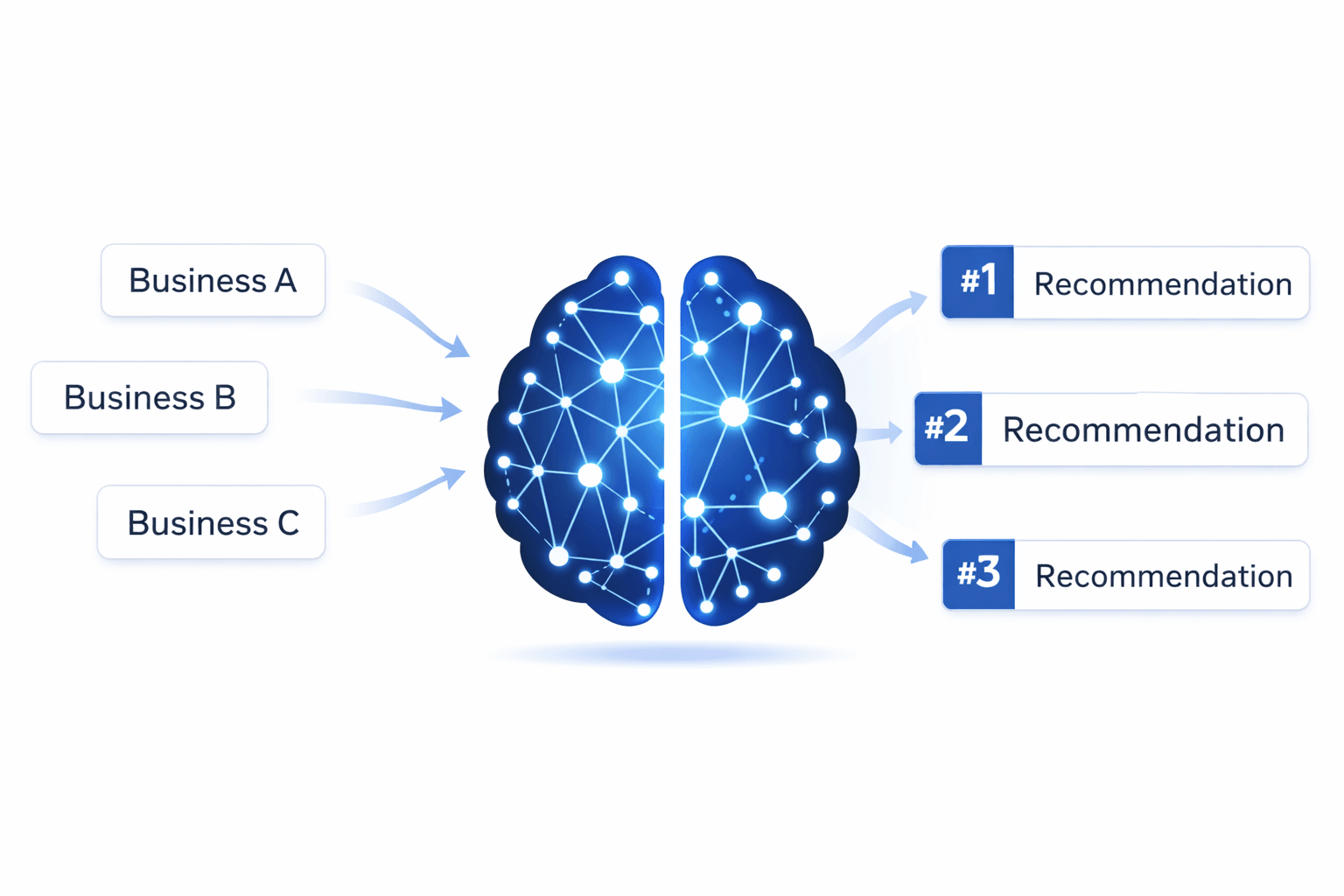
When you ask ChatGPT "what's the best dentist near me?" it doesn't search the web in real time and rank the results. It generates an answer based on patterns in its training data — billions of web pages, reviews, directories, and structured data it was trained on.
Understanding how that process works is the first step to influencing it.
The Short Answer
AI models recommend businesses that appear frequently, consistently, and positively across the authoritative sources they were trained on. The more a business is mentioned in trusted contexts — Google reviews, industry directories, news coverage, structured data — the more likely it is to surface in AI recommendations.
How Different AI Models Work
Not all AI models work the same way. Understanding the differences helps you prioritise.
ChatGPT (OpenAI)
ChatGPT's recommendations come primarily from its training data, which has a knowledge cutoff. This means optimising for ChatGPT is a longer-term play — changes you make today may take months to appear in its answers as the model is updated.
Key signals: review volume and sentiment, directory presence, structured website content, schema markup.
Gemini (Google)
Gemini integrates deeply with Google's own data — including Google Business Profile, Google Maps, and Google Search. If you've optimised well for local Google SEO, you have a head start with Gemini.
Key signals: Google Business Profile completeness and rating, Google Maps presence, Google reviews, local SEO fundamentals.
Perplexity
Perplexity is a real-time AI search engine that actively crawls the web and cites sources in its answers. It behaves more like a search engine than a language model — optimising for Perplexity means optimising for current, crawlable, authoritative web content.
Key signals: current website content, citations in recent articles, directory listings, fast page load times.
Claude (Anthropic)
Claude tends to be more conservative in recommending specific businesses, preferring to provide guidance on how to find businesses rather than naming specific ones. When it does name businesses, it relies on widely-cited, authoritative sources.
Key signals: press mentions, industry authority signals, widely-distributed reviews.
The 5 Factors That Drive AI Recommendations
1. Google Business Profile Quality
This is the single highest-leverage factor, especially for local business recommendations. AI models — particularly Gemini — treat GBP data as a primary signal.
What matters:
- Star rating (4.5+ strongly preferred)
- Number of reviews (more is better)
- Review recency (recent reviews signal an active business)
- Category accuracy (primary and secondary categories)
- Profile completeness (hours, services, photos, description)
2. Review Sentiment and Content
AI models don't just count stars — they read reviews. The language in your reviews shapes how AI describes your business.
If your reviews consistently mention "fast response," "won my case," "very professional," those phrases are likely to appear in AI-generated descriptions of your business. Generic reviews ("great service!") provide less signal.
This is why responding to reviews matters — your responses are also read by AI models.
3. Directory Consistency (NAP)
Name, Address, Phone — these three pieces of data need to be identical across every directory where your business appears: Google, Yelp, Facebook, industry-specific directories, data aggregators.
Inconsistency creates conflicting signals that reduce AI confidence in recommending your business.
4. Structured Data (Schema Markup)
Schema markup is code you add to your website that explicitly tells search engines and AI models what your business is, what it does, and where it's located.
For local businesses, the most important schemas are:
LocalBusiness(or more specific:LegalService,DentalClinic)FAQPageService
Most businesses have none of this. Adding it gives AI models clear, structured signals to work with.
5. Content That Answers Questions
AI models are trained to answer questions. Businesses that have content explicitly answering the questions potential customers ask are more likely to be referenced in those answers.
If someone asks "what should I look for in a personal injury lawyer?" and your website has a well-written page answering exactly that question, you're more likely to appear in the answer than a competitor whose website only has a homepage and a contact form.
What You Can Do Today
- Audit your Google Business Profile — Is it complete? Is your rating above 4.5?
- Check your review content — Are your reviews descriptive or generic? Are you responding?
- Verify NAP consistency — Check that your name, address, and phone match across Google, Yelp, Facebook, and industry directories.
- Add schema markup — If your website has no structured data, this is a high-impact fix.
- Measure your current AI visibility — Before you can improve, you need a baseline.
Get your free AI visibility score
DekAI is an AI visibility intelligence platform that helps businesses understand and improve how they appear in AI-powered search.
See what AI says about your business
Free AI visibility score — how ChatGPT, Claude, Gemini, and Perplexity answer when buyers ask about businesses like yours.
Get my free score